 The Planimetrica Collection
Gerard Sadtler (*1772; †1839), Vienna.
![The k.k. Ingenieur Akademie in the Neubau district of Vienna [1850 plan of Vienna Dominik Biller/Antaria&Co SLUB/Deutsche Fotothek].](https://image.jimcdn.com/app/cms/image/transf/dimension=186x10000:format=png/path/s18b88415449e9b8e/image/ia4e194fc0ebe7f6c/version/1680521720/image.png)

![Winkler's altimeter, made by Sadtler. Winkler, Georg; Beschreibung eines verbesserten, bequemen und einfachen Reise-Barometers, 1821. [E-rara].](https://image.jimcdn.com/app/cms/image/transf/dimension=186x10000:format=jpg/path/s18b88415449e9b8e/image/i8568dd2ef8aa25a2/version/1743142704/image.jpg)
![Winkler's Dendrometer, made by Sadtler; Johann Georg Winkler von Brückenbrandt, Beschreibung eines Dendrometer, 1812. [Universitätsbibliothek Johann Christian Senckenberg]](https://image.jimcdn.com/app/cms/image/transf/dimension=186x10000:format=png/path/s18b88415449e9b8e/image/i4e84af7decfe2d38/version/1743082894/image.png)
![Sadtler's plane table alidade. Lemoch, Ignaz; Lehrbuch der praktischen Geometrie, Vol. 1, Wien 1857, p.136 [Osterreichische Nationalbibliothek]](https://image.jimcdn.com/app/cms/image/transf/dimension=210x210:format=png/path/s18b88415449e9b8e/image/i9b86a5a6d7b09a22/version/1781102479/image.png)
![Sadtler's reflecting rule. Lemoch, Ignaz; Lehrbuch der praktischen Geometrie, Vol. 1, Wien 1857, p.280 [Osterreichische Nationalbibliothek]](https://image.jimcdn.com/app/cms/image/transf/dimension=210x210:format=png/path/s18b88415449e9b8e/image/ib6e60f1abc5f407f/version/1781102479/image.png)
![Sadtler's katoptrische Zirkel. Lemoch, Ignaz; Lehrbuch der praktischen Geometrie, Vol. 1, Wien 1857, p.304 [Osterreichische Nationalbibliothek]](https://image.jimcdn.com/app/cms/image/transf/dimension=210x210:format=png/path/s18b88415449e9b8e/image/i5b12f59dfab7b980/version/1781102890/image.png)
Gerard Sadtler, an important mathematical instrument maker of the first half of the 19th century, was born in Vienna in 1772. Sadtler is referenced in 1803 as a maker of weights and measures in Vega's Mass-Gewichts- und Munz-System. In the same year, Sadtler is referenced in Vega's Lectures on Mathematics as the maker of a "Spiegelzirkel", better known as the Katoptrische Zirkel invented by Hoeschel. For the measurement of the baseline on the Welser Heide for the Austrian geodetic survey in 1806, Sadtler constructed the standard bars that were similar to the ones used by Delambre and Méchain to measure the arc between Dunkirque and Barcelona. He established his own workshop in 1816. From around 1812 to 1822, Sattler lived at Kleine Stiftgasse 187, on the northern side of the k.k. Ingenieur-Akademie, commonly known as the 'Stiftkaserne'. His location within the Stiftkazerne building suggests that he received multiple commissions from the Academy. Indeed, the Handlungs-Gremien und Fabriken Addressen Buch Bd. 1820, lists Sadtler's occupation as a mechanic, and adds "auch k.k. Fortifications Modell-Schlosser".
Exner [Beiträge zur Geschichte der Gewerbe und Erfindungen Oesterreichs, 1873] gives a description of Sadtler's production:
Im Jahre 1816 gründete Gerhard Sadtler seine eigene mechanische Werkstätte; die Hauptleistungen waren der Bau von Messtischen, Perspectiv-Linealen, Compassen, welche Instrumente er hauptsächlich für den Kataster zu liefern hatte. Nivellir-Instrumente, Pantographen, Gruben- Instrumente und Aufnahms-Instrumente für die Mappirung geben Zeugniss von seiner Thätigkeit.
![Sadtler's geodetic standard beam. Kaiserlich-Königliches Militär-Geographisches Institut: Mitteilungen des K.u.k. Militärgeographischen Institutes. 7. 1887 [MDZ]](https://image.jimcdn.com/app/cms/image/transf/dimension=210x210:format=jpg/path/s18b88415449e9b8e/image/i666c7aea70463a7a/version/1781103289/image.jpg)
![3 levelling instruments made by Sadtler. Hauser, Mathias; Analytische Abhandlung der Anfangsgründe der Mathematik ..., 1823. Volume 2, Part 2 [GoogleBooks]](https://image.jimcdn.com/app/cms/image/transf/dimension=210x210:format=png/path/s18b88415449e9b8e/image/i32f89fb012dd9f12/version/1781103289/image.png)

A detailed description of Sadtler's production and from whom he obtained commissions is given by Keess;[Darstellung des Fabriks- und Gewerbswesens in seinem gegenwärtigen Zustande, 1823]:
...Sadtler in Wien 286 Meß- und 445 Berechnungsapparate und 216 Boussolen. Außerdem verfertigte Sadtler die Etalons oder eisernen Normklafterstäbe mit Thermometern, die achromatischen Perspectivlineale, messingene Lehren für die Triangulirungs- und Aufnahms-Sectionsblätter, und Auftragapparate sämmtlich für die k.k. Grundsteuer-Regulirungs-Hofcommission u.a.m. Auch für den k.k. Generalstab hat derselbe viele Instrumente geliefert, worunter der Basis-Messuugsapparat, 2 Theodoliten u.s.w.
Sadtler resided in various locations across Vienna, ultimately establishing himself in the St. Ulrich district at Rofranogaße 27, a house he purchased in 1823 where he remained until his demise in 1839. In 1827 he opened a retail shop in Vienna-centre at Augustinergaße 1157 (fürstlich Lobkowitzischen Hause) and from 1830 at Kärntnerstraße 1043 (Chaossche Stiftungshaus). His widow, Anna, continued to oversee the workshop until at least 1845, and passed away at the age of 86 in Vienna in 1865.
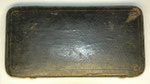
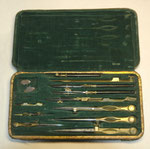


Above is a drawing set of which the case bears the initials GS and the protractor is signed "Sadtler in Wien". Between the lid and tray is a cloth separator. In the lid are 2 wooden triangles, a brass transversal scale engraved with Viennese measures, and a brass semi circular protractor.
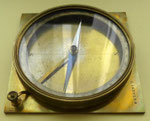
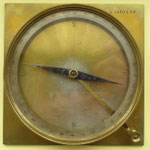
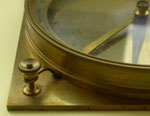

Above is a brass plane table compass, in one corner signed "G. SADTLER". The compass is housed in a wooden case with a sliding lid.