 The Planimetrica Collection
Rochette jeune (fl. 1817-1844), Paris.
![Boussole de Massiat [Laussedat 1898, Tome 1., p.147]](https://image.jimcdn.com/app/cms/image/transf/dimension=211x10000:format=png/path/s18b88415449e9b8e/image/i47e46bc1dc698862/version/1744738177/image.png)

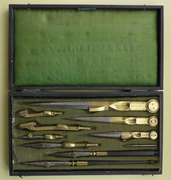
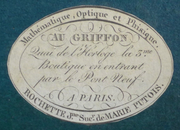
The drawing set above by Rochette jeune is contained within a shagreen-covered case. An inscription is present on the reverse of the lid, reading as follows: AU GRIFFON Quai de l'Horloge la 3me Boutique en entrant par le Pont Neuf A PARIS. The label further indicates that, by this time, Rochette jeune had succeeded Marie Putois.
Rochette père
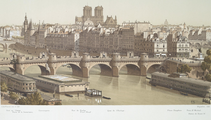
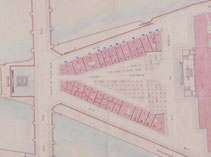
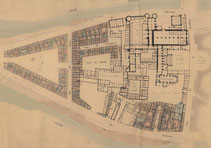
Gaspard Rochette (Rochette père) was born in Annecy, Haute-Savoie, France on 13 April 1755 to Joseph Marie Rochette and his first wife Louise Burin. In 1774, he relocated to Paris, where he was listed as an optician in the Cartes de sûreté á Paris on 04.08.1793, with his residence noted as Quai de l'Horloge. Rochette père is listed as late as in the 1842 Annuaire Général du Commerce at Place Dauphine 28, a property at the rear of Quai de l'Horloge 81. He passed away on 17th July 1846 in Paris.
Rochette jeune
Jean-Jacques Rochette (Rochette Jeune) was born in Annecy, Haute-Savoie, France on 29 October 1777 to the aforementioned Joseph Marie Rochette and his second wife, Marie Dunand [16]. Rochette père and Rochette jeune were in fact stepbrothers and not father and son, as is sometimes asserted. The Cartes de sûreté à Paris have him listed as an optician on 28-03-1795, with a residence on the Quai de l'Horloge 49. On 16 August 1798 in Paris, he entered into matrimony with Jeanne Charlotte Josephine Rochette, who was born on 22 May 1780 in Paris, France. She was the daughter of his stepbrother, the aforementioned Gaspard Rochette, and Jeanne Charlotte Marion. He had a son named Jean-Pierre (1802–1875), whose occupation was listed as an optician at his marriage to Antoinette Marie Victoire Morlot in 1827. On 29 July 1844, Paris saw the passing of Jean-Jacques Rochette, with optician Adrien Désiré Audevard taking the reins following his death. At his marriage to Estelle Louise Mignon in 1828, Audevard's occupation was listed as 'lunetier'. Audevard was born in Paris on 21 March 1804 and passed away on 12 December 1876 in Vincennes [16].
From about 1807 to 1817, Rochette Jeune was associated with Marie Putois (*1746-†1831), daughter of opticien Jean Baptiste Charles Gonichon and wife of optician Etienne Antoine Putois (*1753-†1828). The Paris Almanachs lists the company at Quai de l'Horloge 81. The Almanach du Commerce de Paris of 1817 identifies Rochette jeune as the sole proprietor at Quai de l'Horloge 81. Rochette jeune is renowned for the production of instruments such as grammometers (a type of forestry compass invented by Ingénieur Géographe Michel Maissiat in 1818 [15]), graphometers, telescopes, drawing sets, mining pocket compasses, optical squares and Davy lamps.
Around 1828, Rochette sustained a grave injury in the manufacture of match sticks (briquets oxigénés). The process involved the delicate pulverisation of chlorate of potash, which was then amalgamated with sulphur. This mixture is prone to combustion when subjected to either percussion or even simple friction between two hard bodies, such as a pestle and mortar or a wheel and its table. Rochette was among the first to manufacture match sticks for commercial purposes, and he nearly lost his life in an explosion involving the material he was preparing for this purpose, sustaining injuries that resulted in damages exceeding 1200 francs.
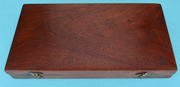
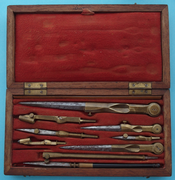

Another set by Rochette jeune, this one in a wooden case. The wooden ruler in this set is by mecanicien Jean Antoine Kutsch (*1758-†1837), a maker of weights and measures, active in Paris from 1803 to 1828.
______________________
NOTES / REFERENCES
[1] Marie Putois is Marie Angélique Catherine GONICHON, daughter of opticien Jean Baptiste Charles GONICHON (1703-1761).
[2] Etienne Antoine PUTOIS 1753-1828.
Il s'établit vers 1785 à l'enseigne "Le Griffon" comme opticien, 87 quai de l'horloge à Paris, paroisse St Barthélémy, où il succédait à la veuve de l'opticien Marie. En 1785 il travaille avec J-Baptiste Grateloup et Alexis Rochon pour développer les techniques de la résine et les télescopes. Il s'associe ensuite avec Rochette jeune. Opticien retiré à Villeneuve sur Yonne après 1817.
[3] Bazar parisien, ou Annuaire raisonné de l'industrie des premiers...1822 p. 450, Gallica.
ROCHETTE jeune, successeur de M. Putois, Instrumens â Optique, Mathématiques, etc., quai de l'Horloge, au Griffon, la troisième boutique en entrant par le Pont-Neuf. Cett maison existe, depuis plus d'un siècle; elle fut toujours avantageusement connue pour la bonne construction des instrumens d'optique, de mathématiques, et principalement celle des instrumens propres à l'exploitation des mines.
[4] Journal des Mines 141 (1808), p. 168.
MM. Marie Putois et Rochette , Ingénieurs en instrumens de mathématiques, demeurans quai de l'Horloge à Paris, ont déjà exécuté avec soin et beaucoup de précision, plusieurs des instrumens dont M. Gallois a donné la description dans son Mémoire, et on peut s'adresser à eux pour s'en procurer la collection cornpiète.
[5] Au Griffon; see Andrew Alpern Collection of Drawing Instruments p. 38-39.
[6] Vasserot Atlas (1810-1836) Paris Archives; Arondissement 11, Neuf.
[7] Type of compass made or sold by Rochette jeune: Brard, C.P. 1824. Nouveaux élémens de minéralogie ou manuel du minéralogiste voyageur, p. 637 and illustration on plate at end of book.
[8] The Griffon and Rochette's name on the shop-front was still visible on an old 1902 photograph by Eugène Atget, Institut National d'Histoire de l'Art.
[9] Collection Nachet. Instruments scientifiques et livres anciens, notice sur l'invention du microscope et son évolution, par Albert Nachet ; liste de savants, constructeurs et amateurs du XVIe au milieu du XIXe siècle -impr. de G. Petit (Paris)-1929
[10] DAUMAS, Maurice; Scientific Instruments of the Seventeenth and Eighteenth Centuries and their Makers (translated by Mary Holbrook 1972) .
[11] TIMBS, John; Arcana of Science and Art, Or an Annual Register of Popular Inventions and ...1830, p.127.
[12] Recueil industriel, manufacturier, agricole et commercial... 1828, p.117
[13] Almanach des 25000 adresses des principaux habitans de Paris ...1817, Volume 3., p.482.
[14] Gaspart Rochette, born 13 April 1755 in Annecy, moved to Paris in 1774, residence Quai de l'Horloge in 04.08.1793, age 39, occupation opticien [Cartes de sûreté á Paris de 1792 à 1795]. Rochette père is listed as late as in the 1842 Annuaire général du commerce at Place Dauphine 28, a property at the back of Quai de l'Horloge 81. The fichiers de l'état civil reconstitué [Paris Archives] have a Gaspard Rochette deceased on 17th July 1846. Marcelin (Dictionnaire des fabricants...) indicates that Rochette père started business on the Quai de l'Horloge in 1794. There is a record [Cartes de sûreté á Paris de 1792 à 1795]: Jean Rochet [sic] 31-05-1793 residence Quay de l'Horloge, occupation opticien, born c.1777 Annecy. Another record [Cartes de sûreté á Paris de 1792 à 1795]: Jean Rochette 28-03-1795, residence Quay du Nord 49, occupation opticien, born c.1777 Annecy, Mont Blanc. Quay du Nord is the old name of Quai de l'Horloge.
[15] Michel Maissiat; Mémoire Sur Quelques Changements Faits À La Boussole Et Au Rapporteur, Suivi De La Description D'un Nouvel Instrument Nommé Grammomètre. Michaud, Paris 1818 [Google Books].
[16] Genealogical data compiled from Geneanet records.
[17] Dictionary of precision Instrument-makers and related craftsmen in France & Switzerland, 1430-1960.